


Blog
Battle Belt vs. Chest Rig: Which is Better?


If you’re new to tactical gear or even a seasoned operator, the debate between a battle belt and a chest rig is one that comes up all the time. Both are designed to carry essential equipment efficiently, but they do it in very different ways.
Choosing the right setup can make a huge difference in comfort, accessibility, and overall mission effectiveness, whether you’re in the field for hunting, airsoft, military training, or law enforcement.
In this blog, we’ll break down the differences, pros and cons, use cases, and even some tips on combining the two for maximum efficiency. Let’s dive in.
What is a Battle Belt?

Source: TUXAPO Tactical MOLLE Battle Belt Collection
A battle belt, sometimes called a war belt or tactical belt, is a heavy-duty belt to carry essential gear around your waist and hips.
It typically holds rifle and pistol magazine pouches, a dump pouch, a holster, a medical kit (IFAK), and utility or multi-tool pouches. Think of it as a mini-platform for your tools, ammo, and accessories.
Battle belts often use MOLLE webbing for modular attachment and are worn over an inner belt for better stability.
What is a Chest Rig?

A chest rig is worn over the torso and secures gear to your chest via adjustable shoulder and back straps. It commonly carries rifle magazines, pistol magazines, admin pouches, a radio, and utility pouches. Chest rigs are popular for lightweight operations, training, and rapid deployment scenarios.
Battle Belt vs. Chest Rig: A Side-by-Side Comparison
Quick Comparison Chart
| Feature | Battle Belt | Chest Rig |
| Weight Distribution | Around the waist | Across the chest |
| Mobility | Excellent for running & kneeling | Excellent for standing movement |
| Capacity | Moderate | High; can carry multiple magazines and tools |
| Gear Accessibility | Easy to reach low-mounted gear | Easy to reach front-mounted gear |
| Armor Compatibility | Works with or without armor | Limited when worn with plate carriers |
| Prone Shooting | Very comfortable | Can interfere while prone |
| Heat Management | Better airflow | Warmer on the chest |
| Fatigue Level | Less upper-body fatigue | Can strain the shoulders |
| Concealability | More discreet | Clearly visible |
| Best Use Cases | Sidearms, quick-access tools, minimalist loadouts | Multiple mags, radios, medical gear, tactical ops requiring chest access |
1. Load Capacity

Source: TUXAPO Tactical Battle Belt
Battle belts are enough for essential pistol and rifle mags, a holster, and small tools. Chest rigs offer higher capacity, easily accommodating multiple magazines, radios, and admin gear.
2. Comfort & Ergonomics
Battle belts excel in running, kneeling, and prone shooting. In comparison, chest rigs excel in standing movement and fast reload drills.
If you carry heavy gear, a belt reduces shoulder fatigue. If you carry light to moderate gear, a chest rig offers better accessibility.
3. Mobility & Prone Position
Battle belts sit low on the hips, making prone, kneeling, and crawling movements smooth and comfortable. Chest rigs can restrict movement when lying prone or bending due to the gear sitting on the chest.
4. Speed & Reload Efficiency
Chest rigs provide faster reloads while standing since mags are directly in your line of sight. On the other hand, battle belts offer very natural reloads for pistol users and smooth transitions during movement.
5. Modularity & Customization
Both systems support MOLLE attachments, but they differ in layout.
Battle belts are ideal for carrying pistol mags, rifle mags, holsters, IFAKs, and dump pouches. Chest rigs, on the other hand, are best for rifle mags, radio pouches, admin panels, and general-purpose (GP) pouches.
You can even combine both for a full tactical loadout, a belt for weapons and medical, a chest rig for communications and support gear.
6. Armor Compatibility
Battle belts pair seamlessly with plate carriers, offloading weight from the shoulders. Many professionals use:
- Plate carrier for armor
- Battle belt for ammo and medical
- Minimal chest-mounted pouches only if needed
In contrast, chest rigs can become bulky and limit mobility when layered over body armor.
7. Quick-Don Capability
Battle belts are faster to put on and deploy, ideal for emergency or rapid situations. Chest rigs take more time to adjust and fit properly, which can slow you down in a hurry.
Pros and Cons of Battle Belts
Pros:
- Comfortable for long wear
- Fast access & quick draw
- Fully customizable
- Great for minimalist loadouts
- Efficient gear organization
- Pairs perfectly with plate carriers or standalone
Cons:
- Limited Gear Capacity compared to full chest setups
- Might interfere with sit-down tasks
- It can shift if not properly secured
Pros and Cons of Chest Rigs
Pros:
- Fast front access
- High carry capacity
- MOLLE and pouch compatible
- Lightweight alternative to armor
- Excellent mobility in dense terrain
- Stand-up reload efficiency
Cons:
- It can cause shoulder fatigue over time
- Less comfortable when seated or driving
- May interfere with shooting
- Slower to don/doff
- Can block movement in the prone position
- Adds heat to the chest area
Choose Battle Belts For…
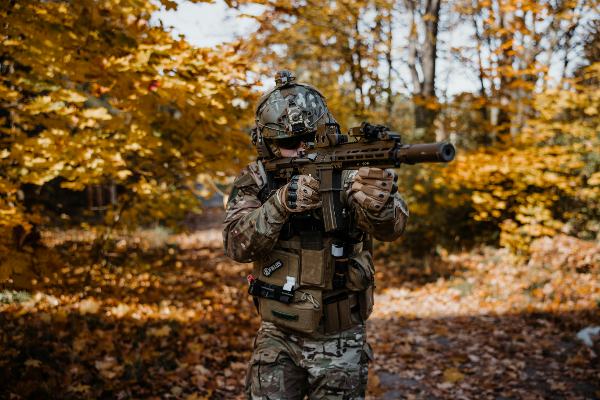
- Military & Law Enforcement: Pair a battle belt with a plate carrier to keep sidearms, radios, and critical gear accessible without overloading the chest.
- Civilian Tactical Training & Shooting Range: Battle belts provide a lightweight, simple setup for everyday drills and practice.
- Airsoft, Paintball & MilSim: Opt for a minimalist battle belt if you want better agility and fast access to pistols.
- Home Defense & Emergency Loadouts: A battle belt is quick to put on, with essential magazines and medical gear ready for immediate use.
- Hunting: Offers fast access to sidearms, ammo, knives, and tools without overloading shoulders. In dense terrain, consider pairing with a tactical vest for higher gear placement.
Choose Chest Rigs For…
- Civilian Tactical Training & Shooting Range: Chest rigs provide fast reloads for flat-range training.
- Airsoft, Paintball & MilSim: Ideal for realism, speed, and carrying multiple magazines.
- Tactical Competitions: Chest rigs excel in competitions where fast reloads and access to multiple magazines are critical.
- Long-Duration Field Operations: Chest rigs are better for carrying radios, maps, and tools over long distances with minimal hip fatigue.
Common Buying Mistakes to Avoid
- Buying a belt without proper inner belt support. Explore the TUXAPO battle belt with an inner belt.
- Overloading a chest rig with unnecessary gear
- Choosing non-MOLLE compatible accessories
- Ignoring body type and waist size
- Not testing prone movement before the final setup
How to Choose the Right Setup for You
Ask yourself these questions:
- Do I move prone often? → Choose a battle belt
- Will I wear body armor? → Choose a battle belt
- Do I need fast, visible reloads? → Choose a chest rig
- Is my mission lightweight and mobile? → Choose a chest rig
- Do I need both pistol and rifle access? → Consider both together
Can You Combine a Battle Belt and a Chest Rig?
Yes. We can use both simultaneously to balance comfort, capacity, and accessibility. This combo helps us offload heavy items to the hips while keeping essential gear within arm’s reach on our chest.
Here’s a typical setup:
- Battle belt for pistol mags, holster, medkit, and small utility pouches.
- Chest rig for rifle magazines, radio, admin pouches, hydration tube, or other mission-critical gear.
This hybrid setup gives you maximum flexibility, balanced load distribution, and mission-ready adaptability. It’s especially popular for military training, law enforcement, and extended field operations.
Final Thoughts
Both battle belts and chest rigs have unique advantages. A battle belt excels in comfort and quick-draw access for minimal gear, while a chest rig offers high capacity and front-accessibility for multiple tools and mags. If you are an operator, combine the two.
If you want a durable MOLLE battle belt, check out TUXAPO.COM


